

The Short Answer
No — age alone rarely disqualifies someone from joint replacement. What matters far more is your overall health, not the number of candles on your last birthday cake. In fact, waiting too long often costs more than surgery ever would — in muscle strength, independence, fall risk, and even mental health.
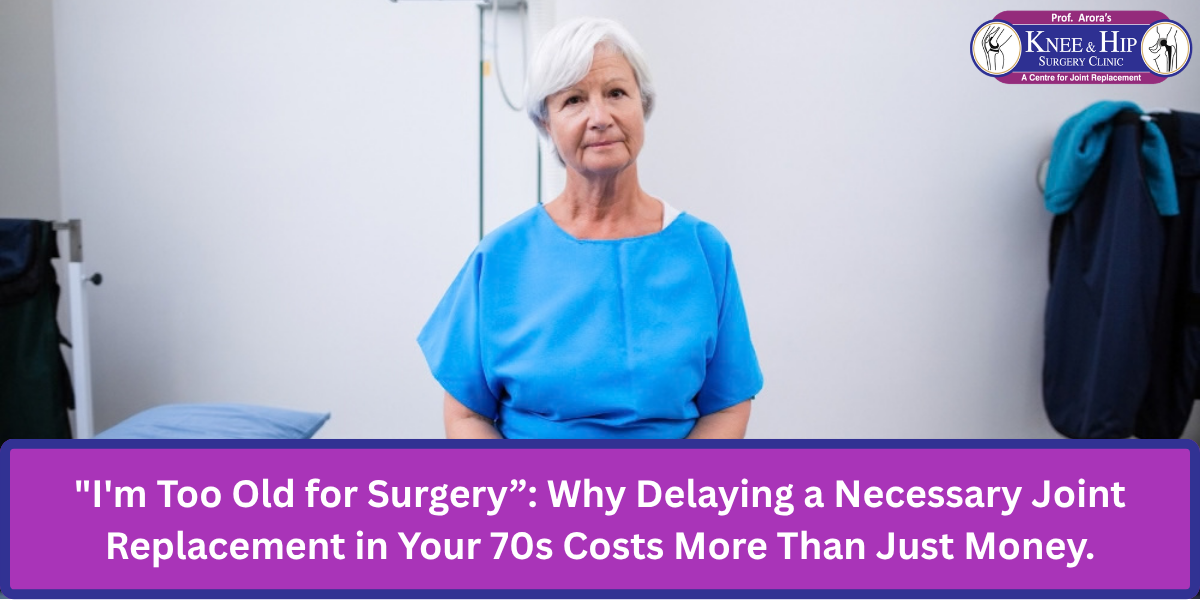
A patient of mine, 74 years old, sat across with me last year and said the same thing I hear at least once a week: "I've had a good life. Isn't it a bit late to be cutting me open?"
She'd been managing her knee pain for six years by then. Not living with it — managing it. Skipping her grandchildren's birthday parties if there were stairs involved. Giving up her morning walk, then her garden, then eventually most of her independence around the house.
By the time she came in, she wasn't just dealing with knee arthritis anymore. She was deconditioned, had gained considerable weight from inactivity, and had started falling occasionally. The surgery itself went fine. But her recovery took twice as long as it should have, simply because her body had spent six years getting weaker while she waited for a "better time."
Is Age Really the Deciding Factor?
Here's what surprises most people: it isn't, or at least nowhere near as much as they assume.
A 2025 study published in the Knee journal compared patients aged 80 and older to patients aged 65–75 undergoing knee replacement. The finding: patients in their 80s showed equal improvement in quality of life and equal satisfaction with their results.
What Actually Determines Whether You're a Good Candidate?
Age is a number on a form. Surgeons care about something else entirely:
- Overall health and how well any existing conditions are controlled — diabetes, blood pressure, heart health
- Bone quality — which is why bone density often gets checked beforehand, especially in patients with osteoporosis
- Baseline activity level — someone who's still reasonably active going in typically recovers faster than someone who's been sedentary for years.
- Ability to participate in rehabilitation — motivation and mental engagement matter as much as physical readiness
None of these are determined by a birth year. A well-managed, active 78-year-old is often a better surgical candidate than a deconditioned 62-year-old.
What Really Happens When You Wait?
This is the part that doesn't get talked about enough. Waiting isn't neutral. It has its own costs, and they compound.
Your muscles weaken. The quadriceps and hamstrings that stabilize your knee, waste away from disuse. Weaker muscles mean a harder, slower recovery whenever you do eventually have surgery.
Your fall risk climbs. This one is serious, and it's backed by real numbers: roughly 30% of people over 65, and 50% of people over 80, fall at least once a year. Add an unstable, painful joint to that baseline risk, and the odds get worse. A fall in your 70s or 80s isn't a minor incident — it can mean a fracture, a hospital stay, or a permanent loss of independence far more disruptive than a planned surgery ever would be.
Other joints start paying for it too. Favoring a painful knee changes how you walk. That compensation puts extra strain on your other knee, your hips, and your lower back — so the damage doesn't stay contained to one joint.
It affects more than your body. Chronic pain and shrinking independence are strongly linked to low mood, anxiety, and social withdrawal in older adults. Skipping the things you love because of stairs or standing isn't a small loss — it adds up.
You may become a worse surgical candidate, not a better one. This is the part I really want people to hear. Waiting "until I'm stronger" often backfires — inactivity leads to weight gain, general deconditioning, and worsening fitness, which can make you a riskier surgical candidate later, not a safer one.
Have a cardiac history? Let's plan your surgery safely.
Dr. Arora coordinates closely with your heart specialists to ensure your health and mobility goals align.
So How Do You Know When It's Time?
There's no perfect universal answer, but a few signs are worth taking seriously:
- Pain that's affecting sleep, not just activity
- Avoiding things you genuinely want to do — not just things that are optional
- Noticing you've become less steady on your feet
- X-rays showing significant joint damage, even if you're "coping"
If several of these sound familiar, it's worth having a real conversation about it — not necessarily booking surgery immediately, but getting an honest assessment of where you actually stand.
The Bottom Line
"I'm too old" is one of the most common reasons I hear for putting off a surgery that could genuinely change someone's daily life — and it's rarely the real barrier it's assumed to be. Health, not age, is what actually determines your outcome. And every year spent waiting has its own quiet cost, one that often outweighs the risks people are trying to avoid.
I'm Dr. (Prof.) Anil Arora, having experience of over three decades of performing Knee & Hip Replacement Surgeries, some of my most straightforward recoveries have been patients in their late 70s and 80s who were simply active and reasonably healthy going in. Age was never the obstacle people assumed it would be.
Been putting off a conversation about joint replacement because of your age? Book an honest evaluation — the discussion costs you nothing, and it may change how you think about the decision entirely.
Every year you wait has its own cost.
Find out what's actually realistic for you — talk to Dr. Arora before deciding to keep waiting.

.png)